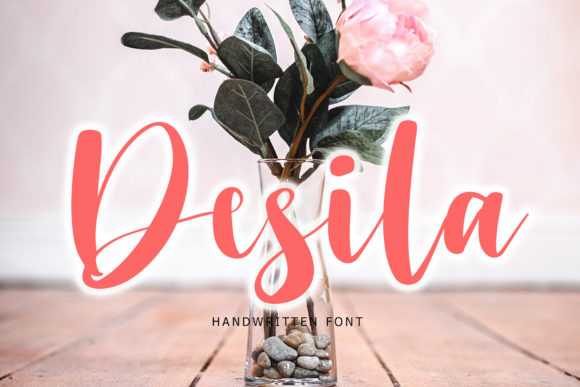
Desila: A Handwritten Font with Delicate Vintage Charm
The right typeface can transform a design, adding personality before a single word is read. Desila accomplishes this with a graceful balance. It is a handwritten font that incorporates delicate script elements, creating a distinctive aesthetic that feels both vintage and modern. This isn’t a harsh, digital script nor an overly ornate historical replica. Instead, Desila offers a soft, approachable character with subtle flourishes that suggest care and craftsmanship.
Why the Details of Desila Matter to Different Creators
Your reaction to a font like Desila likely depends on what you’re trying to achieve. A marketing professional might see it as a tool for elevating brand perception, while a hobbyist making a birthday card might simply appreciate its easy elegance. The 'vintage feel' mentioned isn’t about recreating a specific era; it’s about evoking emotions like nostalgia, authenticity, or warmth. The 'modern' aspect ensures it remains legible and functional across today’s mediums—from a tiny smartphone screen to a large wedding banner.
For someone evaluating fonts primarily for commercial projects, the licensing terms and scalability are immediate priorities. They need to know Desila can be used confidently in a logo that will appear everywhere. A blogger or educator, however, might prioritize how it integrates with their existing website builder or presentation software. The same delicate script elements that a wedding designer loves for invitations could be a concern for a product packaging designer needing extreme clarity; they’d test Desila thoroughly at small sizes to ensure readability remains intact.
Practical Applications Across Projects and Skill Levels
The suggested uses—branding, logos, wedding designs, social media posts, packaging, and more—highlight Desila’s versatility. But how you approach these uses varies dramatically with your experience and goals.
For beginners and hobbyists, ease of use is often paramount. Desila, as a single font file, is typically straightforward to install and apply. You don’t need advanced typography knowledge to see its effect. Imagine using it to create personalized watermarks for your photography or crafting a beautiful header for a family reunion invitation. The font does the heavy lifting, adding a professional touch to personal projects without requiring professional skill.
Experienced designers and professionals look deeper. They evaluate the font’s flexibility: does it have a robust character set with alternate glyphs or ligatures? How does it pair with other typefaces for more complex layouts? They might use Desila not as the main logo font, but as a complementary accent on a packaging label, adding that vintage feel next to a stronger, simpler sans-serif. Their priority is reliability and long-term usefulness within a broader toolkit.
Aligning Desila with Your Specific Needs
Consider your primary intent. Is it creativity, commercial value, presentation, or learning?
Creativity & Expression: If you’re a creator, freelancer, or artist seeking a unique voice, Desila’s handwritten nature offers a direct path. It can make a social media post feel less generic, a T-shirt design more personal, or stationery more distinctive. Your evaluation focuses on how it inspires new ideas and helps your work stand out.
Commercial Value & Branding: Entrepreneurs and small business owners weigh cost against impact. Desila can be a cost-effective way to achieve a high-quality look for a startup logo or advertisement. The key question is whether its vintage-modern blend aligns with your brand’s story. A craft bakery might find it perfect; a tech hardware company might not.
Presentation & Communication: Educators, publishers, and bloggers might use Desila selectively to enhance visual communication. Perhaps for pull-quotes in an article, decorative headings in a presentation, or the cover of a self-published ebook. Here, the priority is enhancing readability and engagement without distracting from the core content. It’s used as a strategic accent.
Learning Value & Skill Development: For those learning design, experimenting with a font like Desila teaches about mood, tone, and application. Trying it out on different mock projects—a fake product label, a wedding invite, a blog banner—helps understand contextual font usage practically.
Identifying If Desila Fits Your Current Project
Before deciding, ask yourself a few practical questions about your immediate task. Does the project require a feeling of personal touch, elegance, or nostalgic warmth? Is the medium primarily visual (like a logo) or does it involve lengthy text (like a brochure)? Desila excels in visual applications and short text blocks. For a long paragraph, a simpler body font would be better, with Desila possibly used for the title.
Also, consider the audience of your project. The vintage feel of Desila might resonate deeply with certain demographics but feel irrelevant to others. A consumer looking for a font for a personal photo album watermark will have different criteria than a marketing professional choosing a font for a nationwide ad campaign. Both might choose Desila, but for profoundly different reasons: one for personal sentiment, the other for calculated brand positioning.
Ultimately, Desila is a specific tool with a particular character. Its value isn’t universal; it’s contextual. It matters most when your project’s desired emotion intersects with its delicate, handwritten style. By focusing on your own project’s goals—whether they’re about ease, impact, creativity, or communication—you can determine if this font’s unique blend of vintage charm and modern functionality is the right choice for your next design.